






Above: Freeform tube bending continuously forms metal as it moves through the machine
October, 2026- The United States is in the midst of a capital-intensive data center buildout phase as AI usage continues to increase. According to PwC, investment is forecast to jump 116 percent between 2024 and 2027 before moderating in the 2030s.
Structural steel and tube demand is following this growth. Steel tube, in particular, forms the framework for data center cooling infrastructure, racks, cable management and wall mounts. As a result, Sharpe Products, a job shop that specializes in custom tube and pipe bending, laser cutting and end forming, is seeing both an increase in customer demand, as well as more requests for a complete part.
“We don’t do nearly as much straight cut a tube, bend it and ship it as we used to,” says Randy Krickeberg, sales manager. “We’re definitely seeing more additional process requests such as slots, holes, notches and custom patterns on a bent tube. Our machines and our capabilities are growing.”
COMPLEXITY
Five years ago, Sharpe installed a BLM 5-axis laser with a robot arm and is seeing growth on the equipment “increase exponentially” in response to customer demand for complex parts and features added after bending. In addition, the company offers freeform tube bending up to 2 inch OD, which is a CNC process used to create continuous-radius, multiradius and complex 3D tube shapes without the straight sections often required by traditional rotary draw bending.
Freeform bending “is a completely different method of production” than traditional tube bending using a die, Krickeberg explains. It allows for sweeping curves, multiple radii, spiral bends and flowing geometries.

Sharpe Products specializes in custom tube and pipe bending, laser cutting and end forming.
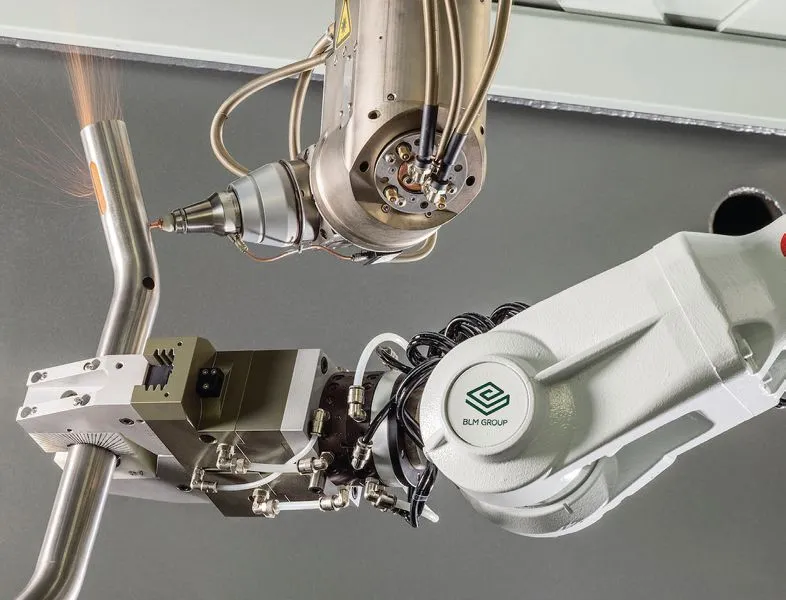
Robotic manipulation allows for precise cuts on complex tubular pieces.
TOOLING IN STOCK
In addition to these higher-end processing options, Sharpe also offers an extensive tooling library with more than 600 bend dies and counting. “We’ve been acquiring tooling for the last 30 years, and we have had a full-time toolmaker in-house for the last 15 years or so,” Krickeberg says.
“Tooling is one of the biggest barriers to entry in the custom bending space,” he continues. “Sometimes it feels like a needle in a haystack to find the right tool to make a part. Having the right tool available to do the job saves money and cuts down on lead times.”
The wide selection of tooling also allows Sharpe to partner with other job shops so they can bid on new work without incurring the cost of tooling. “Unless they’re doing highvolume tube bending production, it doesn’t justify tool costs,” says Krickenberg. “We have bend dies ready to go.” SHAPE AND FIT A recent project using freeform bending allowed the company to complete an engineering- heavy project for a heat-treating elementa coil profile with a tight radius that needs to intertwine with six to 10 other tubes and line up on a plate.
“The tubes need to maintain a certain amount of surface area to heat up,” Krickeberg says. “So it’s a design process to figure out exactly what we can do to ensure these eight intertwined tubes fit at the end. We can change the radius and how the parts align with each other to make them fit but also maintain the length of tubing required.”
He says Sharpe also is starting to see requests for tighter bends in the aftermarket automotive space. “Sometimes, if you’re doing handles or a heat shield for a motorcycle, the fitment is really tight. There’s not a lot of extra room, so our ability to bend higher radii in combination with the five-axis laser, where we can cut holes or cut on the radius, gives us a lot of options for developing parts.
“We try not to treat all challenges the same,” he says. “Understanding the customer is the best way to go about it,” communicating if there’s a less expensive option that will match their project or if tweaks to material choice or radius will create a different set of engineering tests to ensure the part meets their requirements.
BUILDING A FUTURE
BLM Group continues to partner with Sharpe to ensure they are able to execute the designs customers require. “One of our senior manufacturing engineers has been on that machine since day one, gaining the knowledge, and we’re going through the process of getting a second programmer up and running. We have only had one person running the freeform bender and one running the five-axis laser,” Krickeberg says.
“As we’re growing and trying to scale up, we need to duplicate the knowledge and the skill set to not only run the parts now but also to get a good base for repeat work.”
When trying to find employees, Krickeberg says that Sharpe looks more for aptitude than experience in tube bending “because it’s such a niche area. It’s easier to find direct skills for processes like welding and machining.
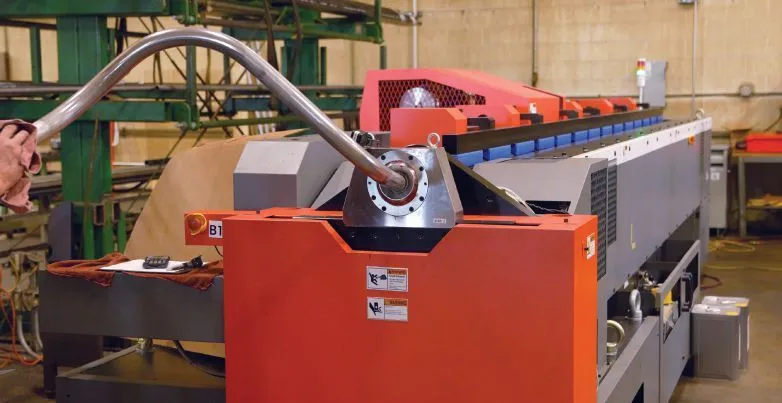
Freeform bending technology can simplify assembly by reducing welds, fabricated joints and secondary manufacturing operations.
But, almost all of our really good long-term employees have not had any kind of fabrication background to start.”
The company has always skewed more toward aptitude and trained people, he says. “We’re lucky to have people on the manufacturing floor who can help train. If you have good long-term building blocks, then you can find people who have potential and get them up to speed quickly.”
Sharpe Products, http://sharpeproducts.com/