







Above: Enmark created a new tool called Envision AI that lets employees throughout an organization access clean data, ask questions and develop smart decisions
August, 2026- Artificial intelligence is everywhere right now. “Because of that, there is a lot of hype,” says Chris Vaughn, vice president for product strategy at Enmark Systems, developer of ERP business software for service centers.
Enmark is looking at AI as a tool. “If you cannot use it, it’s expensive and useless. We are implementing AI in ways that can make a significant difference for our customers—to help them solve problems and create better outcomes like higher profits, greater efficiency and more visibility into data that was harder to see before,” Vaughn says.
Alex Sukhenko, chief technology officer, says the deployment of AI is a competitive necessity, one that customers expect. An equal goal was to focus on how internal operations use AI so that Enmark’s people can do a better job for customers. Everyone in the organization worked on technical planning and scoping, prioritizing projects, and developing products to meet the moment.
“The tools are now giving us more accuracy, more predictability and pushing us to the edges for product specifications,” says Sukhenko. Now, developers, quality assurance engineers, documentation experts are each “able to see the source code and interrogate” what’s working and what does not work.
Normally, he says, only the IT department understands the source code. “The code can now be available to help define scope and test cases, and build a bridge for nontechnical people” so they can make better decisions without first having everything explained. That “lets our support team respond more quickly without involving our product development team, which we would have had to do before.”
In addition, “topics are triaged in detail, which makes it easier and more efficient for developers to look at,” Sukhenko says. “The whole process is now more streamlined; and it’s getting better as we get better.”
The code generated with the help of AI tools is studied, reviewed and rigorously tested; then, every iteration is written faster and better, and the whole process becomes optimized.
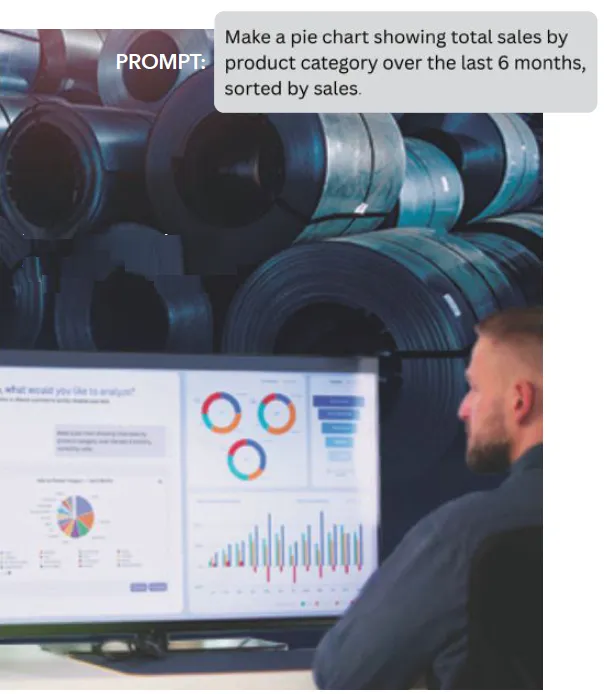
Near-instant analysis and accurate reporting become available with the new tool.
FASTER FEEDBACK
Ben Lion, Enmark’s president and chief operating officer, says AI is very quick at ingesting customer feedback. Previously, “somebody would have to read through hundreds of cases or comments to try to figure out what our customers really wanted. Using AI , we can churn through mountains of data, tons of data points, and find common themes and opportunities to improve the product, where that would have taken months of team time,” he says.
“You’ve heard of trying to hear the signal through the noise? AI really helps you do that,” says Vaughn. “When you leverage AI to help you do that, and do so accurately, it becomes very powerful. AI in particular can digest human feedback like text and voice, which helps us understand customer needs easier and find opportunities to make their lives better.”
GETTING ANSWERS
Enmark Systems developed Envision AI, a tool that works with its Eniteo ERP suite. “All sorts of data is collected through our ERP product. Operators inside the company may need to rely on a business intelligence team or a technical person to extract that data, review it and come back with findings,” a process that was long and arduous, Vaughn says.
Service center employees can make better decisions quickly and accurately when they can access company data. “Envision AI makes that data accessible. We layered artificial intelligence inside of Envision so that a user on the floor or in the sales group could ask a question: What are my average margins like over the last week? What products are selling the most? Which are generating the most profit? Where are we losing margin?”
Vaughn says this information can be used as a coaching opportunity. “I can immediately go talk to the person who isn’t selling at the rate we need them to, rather than waiting for the weekly or monthly readout.” Analysis of the data is much more accessible.
“AI is really good at that. It can take a question and provide an answer without having to click through a highly technical user interface,” he says.
Sukhenko explains that Envision AI is a natural language user interface, much like ChatGPT. “You don’t have to go to your business intelligence team, who is pulling data out of the ERP and staging it into your own database, putting other tools in front of it, taking requests, building reports that you need to look at, iterate through, come back, make comments, have them change it and then, in a week or so, you may settle on a report and then move on to the next.” Instead, users can perform self service in real time by talking to the computer, either by typing or voice to text. “It’s a real game changer for the way you interact,” Sukhenko says. “It empowers people within organizations who aren’t normally even using their ERP. Upper management now has a chance to use something that’s streamlined but leverages all of the data that’s been collected for years by their employees who have been running their business within Eniteo,” he explains.
CURATION
Without the right tools, some people might get caught up in the “noise” AI generates because there’s so much of it.
“We curate the data on their behalf in meaningful, useful ways so they don’t have to worry about that,” says Sukhenko. “That’s Step 1. Step 2 is that we enrich our customers’ prompts through prompt engineering before it is sent to the large language models.
“All the customer sees is a simple prompt. For example, ‘I want a pie chart to show me the top 10 products that have sold over the last six months.’ You submit that and you get an answer in seconds: a pie chart with the data and the results.” Sukhenko notes that the model knows that products and items are the same thing, that “sold” means items that were invoiced, etc.
“We are training and guiding the large language model on the customer’s behalf,” he says. “We fine tune that and make sure it is as accurate as possible. We use the models to interrogate the results to see if they were successful or not and search for signals.
“When we see things that are not working, we zero in on how can we fix that and provide more guidance and more training to the model to make it easier on our customers,” according to Sukhenko. “That’s what they’re really paying us for. It’s their data but, behind the scenes, all the prompt engineering that we have done is the value add. They see it in the results.”
There are risks. Maybe Envision AI users fall down a rabbit hole and they’re looking at the wrong things, for example. “That’s where the guidance comes in—that monitoring of the interactions that our customers are having with our models, on their behalf,” says Sukhenko. “We also go through extensive quality assurance phases for each change that we make. We expect certain things to happen and we try to confirm that to a degree that isn’t paralyzing but is solid before customers touch it.”
SECURITY
Clients want to make sure that their proprietary data is not going directly into the language model to teach it, the risk being that others would be able to access that. “The answer is no,” says Sukhenko. “We send information about the data and we leverage the model to craft only the details we need to allow someone to deal with a natural language prompt. We are not directly exposing our customers’ data to the models.”
Customers tend to want to connect all the data you have: SharePoint, Teams, emails, sales calls, meeting transcripts, source code, work items, support tickets, etc., he says. “You need to be careful not to expose it in a way that other people can take advantage of it in an unauthorized way.
“Enmark takes all security concerns into account,” Sukhenko continues. “There will be examples coming out of people who are doing this haphazardly and who inadvertently open up their proprietary information too much, provide too much access, and then someone will exploit it.”
Vaughn warns that if service centers outsource AI technology to “somebody who doesn’t know how to do it securely and manage the data in a way that it keeps it safe, there is some risk.” Enmark prioritizes handling customer data securely and does not share data with the models “in ways our customers would not want.”
KEEPING UP
Vaughn notes that five years “is an eternity in life cycle of software.” Lion offers a brief internal history: “Just a couple of years ago, a lot of people were still thinking, ‘wow, AI is cool,’ and they were using it to help write blog posts and analyze spreadsheets. That was useful, but the pace of innovation is incredible, and we are now in a completely different place. It has been like going from the Wright brothers to the space shuttle over the past year.”
Adds Sukhenko, “It’s been less than a year [in mid-June] since we dove into it, and we already have a product out there in the field. In five years, if the models continue to get better exponentially, we’ll be able to do that much more for our customers.”
Over time, “there remains a lot of room for improvement over even what’s offered today,” Vaughn says. “Our goal is to become more efficient and promote more profitability for our clients in ways that today aren’t even imaginable.”
Enmark Systems, 800-594-9025, eniteo.enmark.com.