






August, 2026- When every penny is accounted for, service centers and other metals suppliers typically know the cost of their equipment, material, downtime, overhead and production. However, they are less likely to fully know what their storage and material handling outlays total because those costs are distributed, invisible and rarely traced back to the racking systems used.
Patrick McCallin, chief operating officer for Steel Storage Systems, says that the wrong racking system for steel distribution “means lost time wasted when trying to access material; material on the floor, which may cause safety issues; as well as using the wrong type of material handling with the existing racking.”
ACCESS
First, he says, metal processing centers want to avoid not being able to immediately find material and having to hunt it down. Access is merely convenient. “It is the primary performance variable in a storage system, and it compounds across every shift, every day all year round.”
Faster material retrieval means shorter staging time, which means less machine idle time, which translates to higher throughput per shift. Each link in that chain is quantifiable.
Steel Storage Systems Inc. (SSSI) builds sheet racks and SpaceSaver Racks, as well as conveyor equipment.
SpaceSaver Racks are roll-out cantilever storage racking for bar, pipe, tube, beams and other long products and accommodate a large variety of material types, sizes and weights. The SpaceSavers are double-sided, vertically stacked storage receptacles available up to eight levels tall and in lengths up to 60 feet. The enclosed receptacles roll out laterally for loading or retrieving material with an overhead crane. Standard receptacle sizes are 20, 24, 30 and 36 inches wide and 12 or 15 inches tall.
The company’s standard sheet rack models have four to eight roll-out storage levels with up to 10,000 pounds of capacity per drawer. This system can store any heavy flat product including plate, fixtures and dies. Roll-out sheet racks feed laser cutters, plasma cutters, shears, press brakes and other production machinery.
KEEPING BUSY
“Our sheet storage solution is not for high density, such as 30 different cassettes at a time for 30 different size and material types,” McCallin says. “Our niche market is low-density storage designed to be used in conjunction with a press brake or plasma cutting machine. You spend a lot of money on those machines and want to keep them busy.”
A majority of service centers and processors don’t find the automated storage tower to be the most effective and affordable solution for their operations. “Our solution is a small racking system put right next to an operation cell to keep the machines in production,” he explains.
The system is well suited to staging jobs, as the racks can load or unload from the front or the back, using a forklift or overhead crane.
“The drawback of automation is expense,” McCallin says. “The footprint is large, too. You need room to load the cassettes and more equipment to load up your table. Ours is fast and compact.”
SpaceSaver Racks can accommodate two worlds. “It is a modular density storage solution so we can make it work for distribution centers with vast inventory or for the fabricator that is running a small business,” says Carrie Green, head of marketing and inside sales.
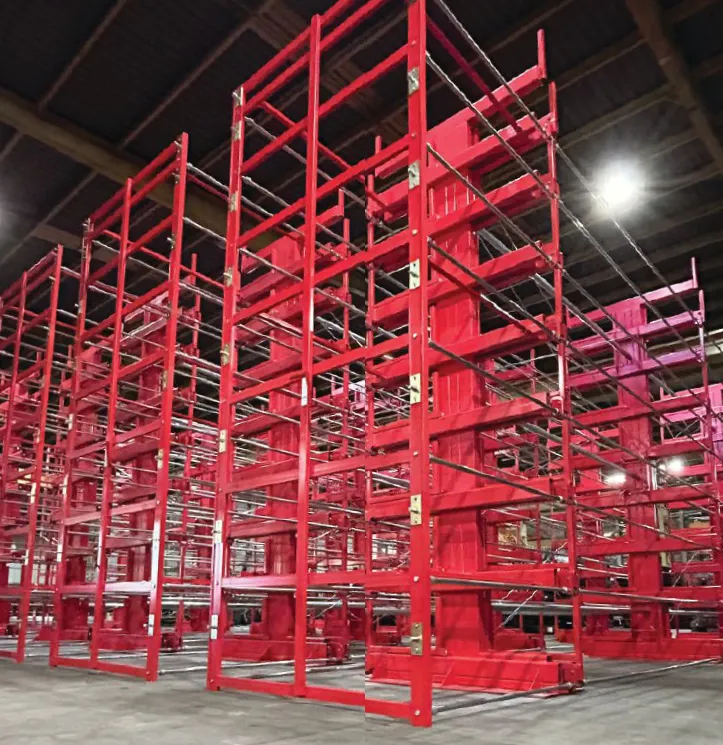
The SpaceSaver Racks are doublesided, vertically stacked storage receptacles available up to eight levels tall and in lengths up to 60 feet.
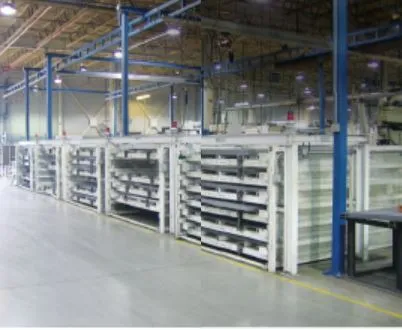
SSSI’s niche market is low-density storage designed to be used in conjunction with a press brake or plasma cutting machine.
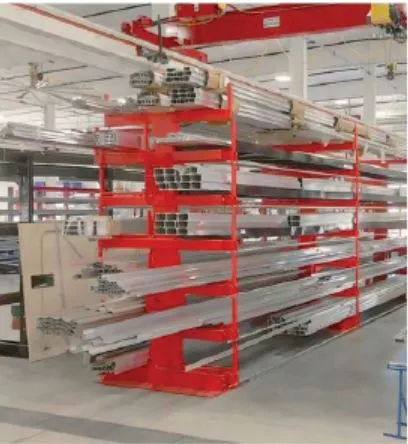
The goal of the storage racking system is to create flow across the plant, which leads to efficiencies.
DESIGN NOTES
To configure the racking system properly, “we normally look at a three-dimensional picture of the customer’s plant,” McCallin says. First, “we look at the floor space to lay out material.” For example, the bay size is 250 by 75 feet. “We can lay everything down here.” Next, “we are looking at all the height available underneath the overhead crane and hoist, and use that space.”
In addition, says Green, “if you have a lot of one product and offcuts of another, we study the materials how much you have of each. So if you need 30 racks 12 feet long and five racks that are 20 feet long, we look at where the machinery is and the space between the racks.” The goal, she says, is to create “flow across the plant.”
SSSI makes sure that its racking systems will work with the existing material handling equipment. “We ask what types of crane the customer is using,” McCallin says. “The main thing with SpaceSaver is it’s designed to complement overhead cranes. Where it fits in the product mix of storage systems is in the middle.”
For example, there are stacker buckets, “kind of like puzzle pieces, which is the cheapest option for vertical height but you lose efficiency,” he says. “Dead inventory sits at the bottom of the stack and, once in a blue moon, you have to pick that for an order. An operator has to dig through the stack, which takes at least 20 minutes.”
Green says that with SpaceSaver, users have immediate access: “You know where everything is at ‘my material for 20 feet is here.’ Each receptacle can hold a different SKU, and the system knows how to pick that material.”
The SpaceSaver Rack comes at a higher price point than some other racking systems “but you are moving that material much faster. And it’s same for slow-moving and fast-moving inventory,” she says.
“If you are doing a whole warehouse, SpaceSaver is not the greatest fit,” McCallin acknowledges. A honeycomb system, for example, is so large that “facilities are built around them,” which can be “very costly. You must have enough shipments per day to justify that.”
INTEGRATION
“A great part of our racking systems is you use the infrastructure you already have,” Green says. “They go wherever you have room. We have a one-sided rack to place along a wall. We have large racks at a fraction of the investment. You don’t have to buy more real estate. That’s an immediate return on investment.”
According to McCallin, “we are middle of the road for cost and efficient at picking orders. A whole bay of racking might cost $700,000 but the customer gets a lot of storage from that.”
Green says that if a company saves 20 minutes per shift picking material correctly, that is 83 hours per year in efficiency. “The time you are not using your machines is time spent not making money. If you are feeding the machines,” the bottom line is enhanced.
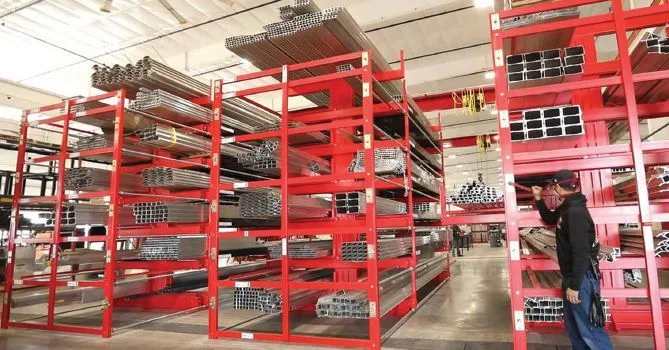
Customers are able to use the space and infrastructure they already have.
DURABILITY
The SpaceSaver racks were first engineered in the late 1960s for distribution and industrial environments. “All this time, we still make them as robustly,” says McCallin. Tubing with 1/4-inch thick walls is used for structural supports. Steel tubing is used for the crank-out mechanism. “It’s an all-weather design. We have replacement parts in inventory. The racks we use here are at least 30 years old,” he adds.
“Some other systems require a lot of maintenance,” says Green. “Ours are low maintenance and handle massive amounts of weight.”
They are engineered to be simple to operate and have few moving parts. The racking system design “needs little improvement when it’s built right in the first place,” Green says.
For customers with questions, “we send them a parts drawing with an exploded drawing of components and keep our parts in stock to quickly quote and ship,” McCallin says.
All racking systems are built in house. “We have CNC machines to produce parts at low cost. If a customer needs anything to get their racks up and going, they get the parts overnight, however they prefer,” he says.
The company will install. “We will go on site and provide a quote for a turnkey rack installation to shim and level in place, and show them how to best utilize it.” Repair service is available. “Say there is a rack that was bumped by a forklift and geometry is skewed. We can provide tech service to come out and get the rack back to working configuration.”
SAFETY FEATURES
SSSI racks are engineered to carry heavy items but are still easy for individuals to roll or crank out “and not worry about material falling,” Green says. “That’s much better than material sliding around on the floor. Your crane operator doesn’t have to climb or get up on stairs. One person can load and unload. All lifting is done with a crane. The heights are manageable. Everything is where it’s supposed to be.”
Steel Storage Systems Inc., 800/442-0291, steelstorage.com.