





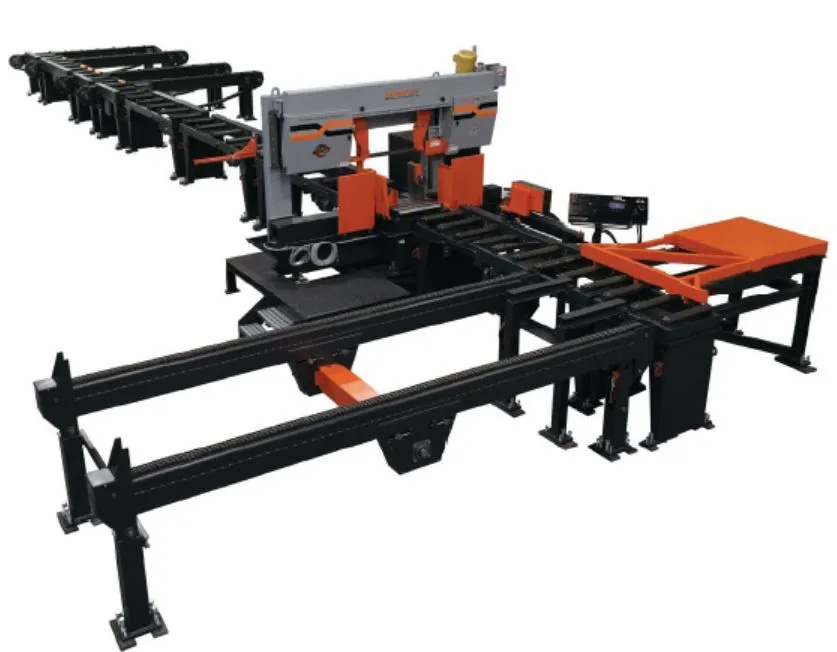
Written by: Hem Saw StaffAbove: Integrated systems move material across tables, cross transfers and loading arms to maximize handling and processing
November, 2026- Metal sawing has always been a balance of cutting speed, blade life, accuracy and material handling. Today, however, the definition of a high-performing saw is expanding. The machine is no longer simply a mechanism for moving a blade through metal. Increasingly, it is a connected production system capable of sensing conditions, adjusting cutting parameters, communicating production data and coordinating material movement.
That shift is being driven by the same forces affecting the broader metalworking industry: pressure to produce more with fewer operators, increasingly demanding materials, greater expectations for repeatability, and the need to understand where production time and cost are being lost.
OPERATOR KNOWLEDGE
Sawing has traditionally relied heavily on operator knowledge. Experienced operators know how a blade should sound and behave, when feed pressure needs to be reduced and when a cut is beginning to drift. That knowledge remains valuable, but modern controls and sensors are increasingly allowing machines to capture and respond to the same conditions.
For example, monitoring cutting force, feed rate, blade tension and squareness can provide a much clearer picture of what is happening during a cut. Rather than operating at a fixed feed rate regardless of changing conditions, a machine can use controlled parameters to maintain more consistent cutting performance.
This is particularly important as manufacturers process a wider range of alloys and harder materials. Cutting conditions that work well for carbon steel may not be appropriate for stainless, tool steel or other difficult-to-machine alloys. A more intelligent control system can help optimize the relationship among blade speed, feed rate and cutting pressure.
The result is not necessarily simply a faster saw. It is a saw that can spend more of its operating time in the productive cutting window.
PROTECT THE PROCESS
One of the most important developments in modern sawing is the ability to respond to changes during the cut.
Blade wear is a good example. As a blade dulls, cutting forces can change and the blade may begin to deflect. That can lead to out-ofsquare cuts, additional material handling or downstream machining. If the machine can detect that at the beginning, corrective action can be taken before the problem becomes a rejected part.
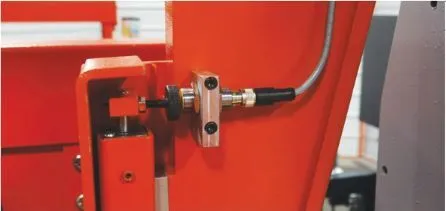
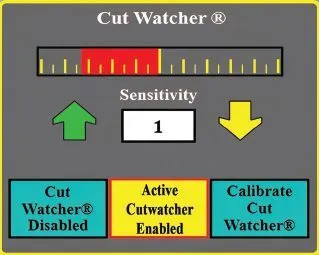
Active monitoring systems are an example of this approach. HE&M Saw’s Cut Watcher technology monitors cutting squareness and can respond when a preset deviation is exceeded. The active version can dynamically increase blade tension to counteract blade deflection and help maintain a straight cut as the blade wears.
This represents an important change in philosophy: Instead of treating blade wear as a reason to stop production, the machine can compensate for predictable changes in the cutting process.
Adaptive control also can help protect the blade from overload. Programmable cutting pressure and feed control allow the machine to operate within appropriate limits rather than relying solely on an operator to make adjustments. That becomes increasingly valuable as shops seek consistent results across multiple shifts and operators.
A PRODUCTION ASSET
Another major trend is connectivity. A modern saw can generate considerably more information than simply the number of pieces cut. Production counts, cycle times, machine status, maintenance conditions and other operating information can provide insight into the performance of the entire sawing operation.
HE&M Saw’s Smart Saw control platform, for example, incorporates MTConnect connectivity, allowing machine data to be shared through a common communication standard. Production monitoring can help manufacturers identify how many cuts are being made, how quickly parts are being produced and where bottlenecks may exist.
That information changes the questions a production manager can ask.
Instead of asking why the saw didn’t make its quota, management can begin examining cycle time, downtime, material handling, blade changes and other factors that contribute to overall equipment utilization
The distinction is important because a saw’s theoretical cutting rate does not necessarily determine its actual productivity. A machine capable of cutting quickly can still underperform if operators spend excessive time loading material, measuring stock, changing blades or waiting for downstream processes.
With Cut Watcher, instead of treating blade wear asa reason to stop production, the machine cancompensate for predictable changes.
HE&M Saw’s Cut Watcher technology monitors cutting squareness and can respond when a preset deviation is exceeded.
VITAL ACCESSORIES
The next step is connecting the cutting machine to the material around it. Automatic bar feeds, powered conveyors, loading systems, discharge equipment and sorting systems can reduce the amount of manual intervention required between cuts. This is especially important in high-volume operations, where material handling can become the limiting factor rather than cutting speed.
Integrated material handling systems can coordinate loading, positioning and discharge so the saw spends less time waiting for its next piece. HE&M Saw, for example, offers conveyor tables, cross transfers, loading and discharge arms, measuring systems and other handling equipment designed to move material efficiently through the sawing process.
Companies are now seeing these components as one production system rather than as individual pieces of equipment. That approach also addresses labor availability. Automation does not necessarily mean eliminating the operator. Instead, it can move the operator away from repetitive material movement and allow one person to oversee more production.
THE PROCESS CENTER
Despite all the advances in controls and automation, the blade remains at the center of the process.
A sophisticated saw cannot compensate indefinitely for the wrong blade, incorrect tooth geometry, poor blade tension or inadequate coolant management. Modern sawing technology therefore increasingly combines machine intelligence with advances in blade materials, coatings and tooth design.
Carbide-tipped blades, for example, have expanded the capabilities of band saws when cutting difficult alloys and high-value materials. Precision tooth geometry is particularly important because each tooth is effectively a small cutting tool. The machine and blade must therefore be treated as a system. Higherperformance blades can create opportunities for increased cutting rates, but only when the saw can deliver the required control, rigidity, tension and feed performance.
SYSTEM-LEVEL EFFICIENCY
The most significant trend in sawing may be the shift from optimizing individual cuts to optimizing the entire cutting process. A faster, longer-lasting blade and a faster materialhandling system are beneficial. But the greatest gains can come when those technologies work together.
Consider a production cell in which material is automatically loaded, measured and positioned; cutting parameters are controlled electronically; blade condition and squareness are monitored; finished pieces are automatically discharged; and production data is available to management. The objective is no longer simply to maximize blade speed. It is to maximize productive hours while minimizing scrap, downtime, labor requirements and cost per cut.
That is where connected sawing is being directed. For metal processors, the opportunity is to look at the saw not as an isolated machine, but as a data-generating, decision-making component within the larger manufacturing process. As automation, sensing and machine connectivity continue to advance, the saw of the future will increasingly be defined not only by how quickly it cuts, but by how intelligently it manages the cut.
In an industry where every cut represents material, time and energy, that intelligence can make a measurable difference.
HE&M Saw, hemsaw.com.